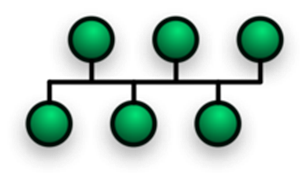
A bus topology is a topology for a Local Area Network (LAN) in which all the nodes (workstations, printers, laptops, servers etc) are connected to a single shared communication line / cable, called a bus , with a terminator at each end .The cable to which the nodes connect is called a “backbone”.
All nodes are connected to the linear cable through T connectors. The terminator is used to absorb the signal when the signal reaches the end, preventing signal bounce. In this topology, when a computer sends out a signal, the signal travels the cable length in both directions from the sending computer. When the signal reaches the end of the cable length, it bounces back and returns in the direction it came from. This is known as signal bounce. Signal bounce may create problems in the computer network, because if another signal is sent on the cable at the same time, the two signals will collide. Collisions in a computer network can drastically reduce the performance of the computer network.
Bus networks may have problems when two clients want to transmit at the same time on the same bus. Thus systems which use bus network architectures normally have some scheme of collision handling or collision avoidance for communication on the bus, quite often using Carrier Sense Multiple Access or the presence of a bus master which controls access to the shared bus resource
Multiple Access: each station has access to the common bus
Carrier-sense multiple access with collision detection (CSMA/CD) is a media access control (MAC) method used most notably in early Ethernet technology for local area networking.
It uses carrier-sensing to defer transmissions until no other stations are transmitting. This is used in combination with collision detection in which a transmitting station detects collisions by sensing transmissions from other stations while it is transmitting a frame. When this collision condition is detected, the station stops transmitting that frame, transmits a jam signal, and then waits for a random time interval before trying to resend the frame.
CSMA/CD is a modification of pure carrier-sense multiple access (CSMA). CSMA/CD is used to improve CSMA performance by terminating transmission as soon as a collision is detected.
Carrier sense: each station first listens to check if no other station is transmitting before sending data
If medium is busy, station must wait a random interval and try again.
Advantages
- Relatively easy to install, simplest way to connect multiple clients
- Requires less cable length than a star topology.
- cost effective
Disadvantages
- Entire network shuts down if there is a break in the main cable.
- Complex protocols (common bus)
- No centralized control
- Fault detection and isolation (suppose a node is infected with virus ) is not easy
- Not easy to expand
- Not meant to be used as a stand-alone solution.