1. Introduction
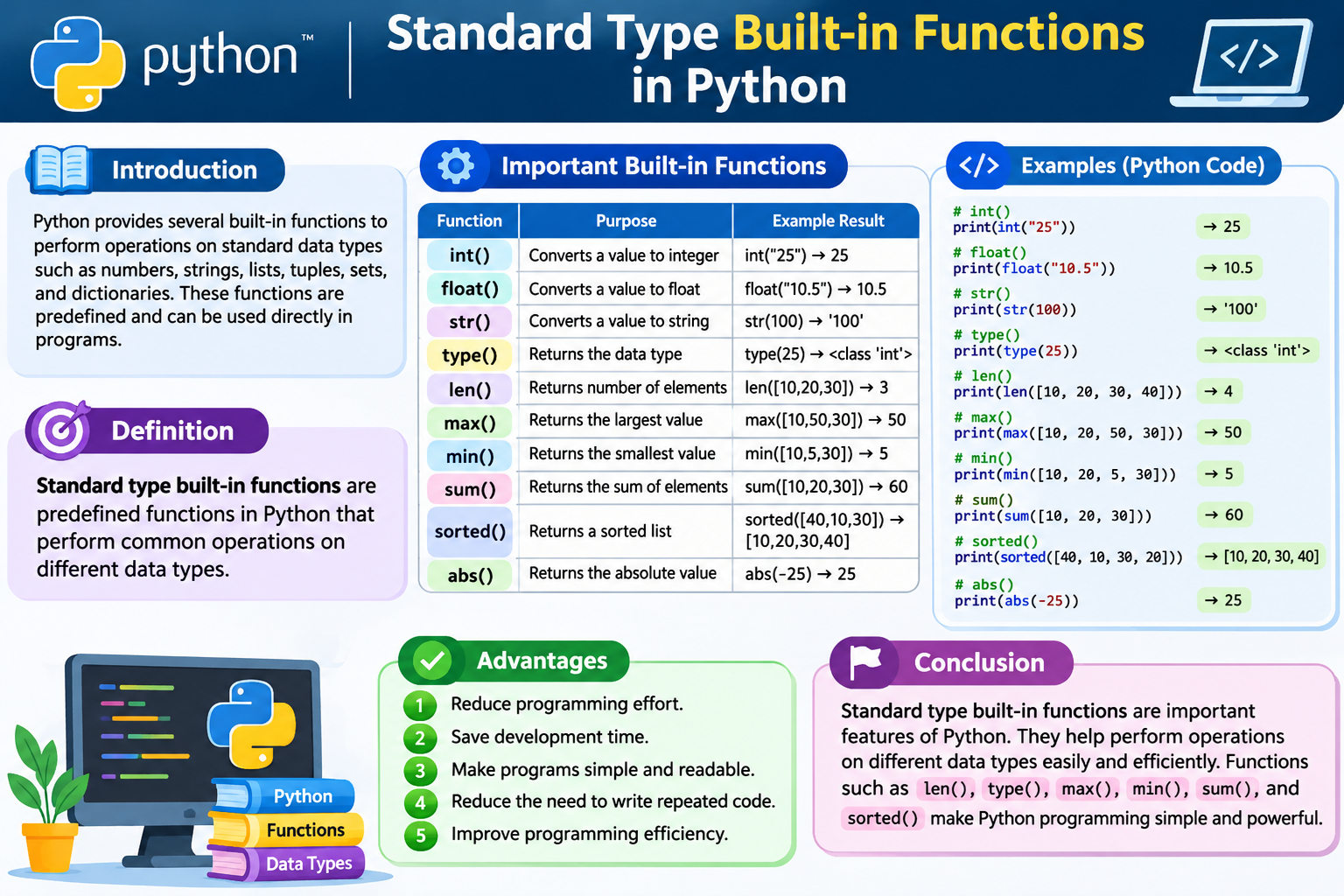
Python provides several built-in functions to perform operations on standard data types such as numbers, strings, lists, tuples, sets, and dictionaries. These functions help programmers perform common operations easily without writing additional code.
https://www.twincafe.com/sahaja?referral=JndtGLcX
Standard type built-in functions are predefined functions available in Python that can be used directly in programs.
2. Important Standard Type Built-in Functions
1. int()
Converts a value into an integer.
Example:
x = int("25")print(x)Output:
252. float()
Converts a value into a floating-point number.
Example:
x = float("10.5")print(x)Output:
10.53. str()
Converts a value into a string.
Example:
x = str(100)print(x)Output:
1004. type()
Returns the data type of a variable.
Example:
x = 25print(type(x))Output:
<class 'int'>5. len()
Returns the number of elements in a sequence or collection.
Example:
a = [10, 20, 30, 40]print(len(a))Output:
46. max()
Returns the largest value from a collection.
Example:
a = [10, 20, 50, 30]print(max(a))Output:
507. min()
Returns the smallest value from a collection.
Example:
a = [10, 20, 5, 30]print(min(a))Output:
58. sum()
Returns the sum of all numerical elements.
Example:
a = [10, 20, 30]print(sum(a))Output:
609. sorted()
Returns a sorted list of elements in ascending order by default.
Example:
a = [40, 10, 30, 20]print(sorted(a))Output:
[10, 20, 30, 40]10. abs()
Returns the absolute value of a number.
Example:
print(abs(-25))Output:
253. Advantages of Built-in Functions
- They reduce programming effort.
- They save development time.
- They make programs simple and readable.
- They reduce the need to write repeated code.
- They improve programming efficiency.
4. Conclusion
Standard type built-in functions are important features of Python. They help perform operations on different data types easily and efficiently. Functions such as len(), type(), max(), min(), sum(), and sorted() make Python programming simple and powerful.